Many customers encountering Business Central for the first time struggle to understand why it’s necessary to enhance Microsoft’s standard system with so many third-party apps. Often, when implementing a new ERP, the mantra is “let’s stick to the standard”. Well, sure: what could possibly be different about the customer’s processes compared to those of hundreds of thousands of other users of the product? The logic seems sound.
Let’s take a look at an example. 😅
National Medicines Verification System (NMVS)
In 2015 (the year we migrated from NAV 2013R2 to NAV 2015), the European Community agreed on a new system to combat pharmaceutical counterfeiting. This platform, known as NMVS, would soon or late significantly change the pharmaceutical supply chain. Without getting into technical details, how it works is quite simple: the drug manufacturer requests a certain number of unique serials and prints them on product boxes; the intermediate logistics system ensures the tracking of box movements; the pharmacist verifies the validity of the box by querying the database and deactivates the serial number immediately before dispensing the drug to the customer. From that moment on, the drug is considered “dispensed” and can no longer circulate.
Beyond counterfeiting, there is also the issue of healthcare spending. For those living in Italy, like me, the adhesive “stickers” on the back of medicine boxes are well known. Each of these stickers represents funds that the healthcare system recognizes to the pharmacy in exchange for products dispensed without direct payment, requiring only a medical prescription. But what happens to the stickers on all other boxes that are paid for, exported, or destroyed? Well, the NMVS system could change all of this.
But how does this relate to Business Central?
The “Lot No.” issue
For the past few weeks, we have been actively testing NMVS. The deadline for adopting the regulation in Italy is set for February 9, 2027. Pharmaceutical distributors have received sample QR codes, as they will appear on the boxes, to perform query tests against the NMVS platform.
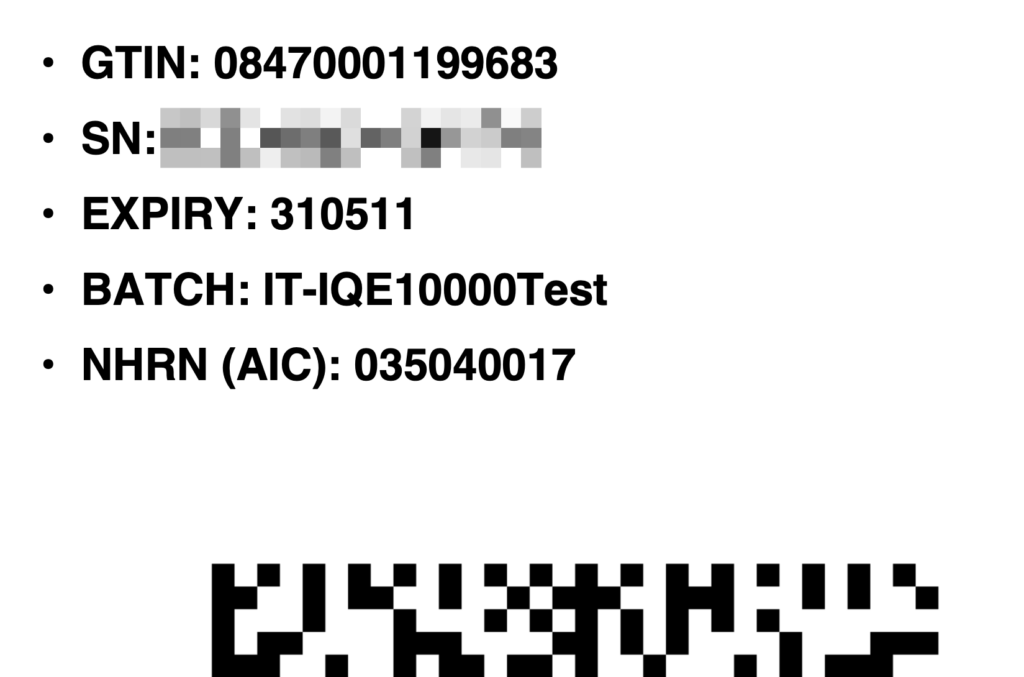
Do you notice anything unusual? 😅
EU A2 – Uppercase / Lowercase Mismatch
Why this happens
Batch IDs are case-sensitive. Differences between uppercase and lowercase characters may therefore result in an A2 alert.
How to prevent it
Enter Batch IDs exactly as encoded on the pack.
When entering Batch IDs manually, verify that Caps Lock or other keyboard settings have not altered the characters.
Yeah! The batch number in the NMVS system is case-sensitive. And not just recently, it has been that way for over 11 years now. 😅
“Reservation Entry” table
In Business Central, the world of traceability revolves around the “Reservation Entry” table. Let’s just say it has very little to do with actual “reservations”… but that’s a story for another time. In version 29, the latest release just a few days ago, the “Lot No.” field is defined as follows:
        field(5400; "Lot No."; Code[50])
        {
            Caption = 'Lot No.';
            ToolTip = 'Specifies the lot number of the item that is being handled with the associated document line.';
        }
As the documentation states, the “Code” field “denotes a special type of string that is converted to uppercase and removes any trailing or leading spaces”.
So, can you see the problem now? The entire standard traceability framework in Business Central, as defined even in the latest version, is unusable for pharmaceutical regulations. And we’re talking about hundreds of thousands of companies that manufacture, distribute, and sell pharmaceuticals across Europe!
Conclusion
Business Central is a wonderful, versatile, and powerful product. No matter how much effort Microsoft puts into bringing more features to the “standard” level, BC is so scalable that it works for both the pizzeria down the street and large manufacturing companies. There will always be aspects that make the product “general purpose”. This is precisely why third-party apps exist: they make the product “vertical” and specific to certain market sectors.
In our pharmaceutical apps, we rewrote the entire standard traceability engine as a first step. It’s a “enormous” piece of work that, when we talk about it, often meets with disbelief or skepticism from our audience.
Well, this “case-sensitive” issue was a great reason to do it!